Flotiq Use Case
.png)


Why is Headless CMS Important in E-commerce?
In a headless CMS, content management is the central element. Such systems allow you to create, organize, and share content, which can be displayed on websites, mobile apps, or other channels. Meanwhile, the e-commerce domain covers managing products, orders, inventory, as well as handling payments and returns. Flotiq can serve as a bridge between both areas.
Products: A Key Element of Both Content and E-commerce
In e-commerce, products are part of both content and order management. A product can appear in various sections of the store, such as the product list, the "new arrivals" section, or a landing page promoting upcoming sales. At the same time, the same product will be part of an order, found in the shopping cart, and its stock levels will be tracked.

Convenient solutions should enable the use of products in both the e-commerce and content sections. An example of such an approach could be the two-way synchronization of products between Flotiq and the e-commerce system, allowing for the creation of relationships between content and products.
Team Workflow and E-commerce Implementation
When implementing e-commerce solutions based on headless CMS, it's crucial to adapt the tools to the client team's workflow. Consider the following question: Will two teams handle the application—one managing orders and the other managing content? Or is it a single team handling the entire process?
Answers to these questions help determine which technological solutions will be most efficient. For instance, if a company prefers to work in a single system, Flotiq can function as both a CMS and a product management tool. In other cases, it might be better to split the functionality into specialized applications.
Adapting to Client Processes: Does the client need a unified system, or do they prefer to separate functionalities across different applications? The e-commerce process should align with the team’s structure.
—
What’s the Foundation: Content or E-commerce?
Another important consideration is understanding which e-commerce elements are key to the project. Is it a standard online store with a product list and filtering, or a more unique platform, such as a site dedicated to selling single products or event tickets?
Depending on the answer, the focus might shift towards content management (e.g., events, blogs), while e-commerce functions will play a supporting role.
Defining Client Needs: Does the client expect standard e-commerce functions, or is the project more unique, with content being the main element of the platform?
—
Example Approaches to Flotiq E-commerce Integration
Based on various client needs and team structures, several approaches to integrating Flotiq with e-commerce can be distinguished.
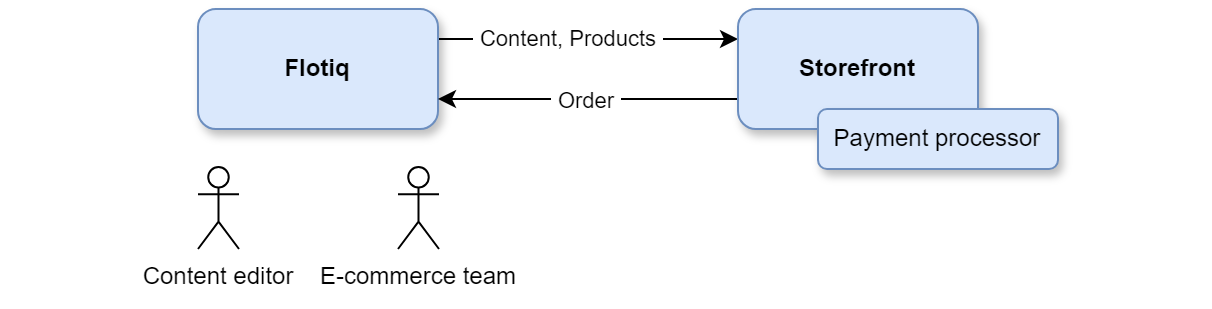
1. Flotiq + Payment Processor: Comprehensive All-in-One Solution
In this approach, Flotiq serves as both a CMS and a product management system. Order processing is handled through an external payment processor, such as Stripe. This solution is ideal for companies wanting to manage all elements from one system.
Advantages:
- Unified system for managing content and products
- Easy linking of products in strictly content-driven sections
- Full control over the payment process
Aspects to consider:
- Requires implementing communication with the payment processor
2. Flotiq + E-commerce Platform: Advanced Solution for Larger Teams
For larger implementations with separate content and e-commerce teams, we recommend using Flotiq for content management and an e-commerce tool for handling payments and orders. A good example is Medusa, a popular open-source headless e-commerce solution. Both systems can collaborate through two-way product synchronization, with deeper integrations possible using Flotiq plugins.

Advantages:
- Dedicated tools for both teams (content editor, e-commerce)
- Two-way synchronization enables linking products in content-specific sections
- Both systems can be extended with specialized plugins
Aspects to consider:
- Advanced implementation
- Additional system maintenance required
3. Flotiq + Snipcart: Simple Solution for Smaller Teams
In this configuration, Flotiq stores content and products, while Snipcart is used for order processing and cart management. This solution is ideal for smaller projects where integration needs to be quick and straightforward.
An example of such integration is our Next.js e-commerce starter (refer to the sources or view the live demo).

Advantages:
- Simple and fast technical integration
- Ability to add e-commerce functionality to an existing system
Aspects to consider:
- Additional costs due to Snipcart commissions
- Limited flexibility as some e-commerce responsibilities are transferred to an external system
Conclusion
Flotiq can serve as the foundation for e-commerce solutions or integrate with existing processes. The key is adapting the tools to the client’s needs and team structure, which greatly impacts the success of the implementation. Whether it’s a complex or simple project, Flotiq offers flexible and scalable solutions that can meet various requirements.