CMS
CMS


Introduction
In today’s hyper-connected world, businesses face mounting pressure to deliver content seamlessly across websites, mobile apps, social media, and emerging digital platforms. Customers expect consistent, up-to-date information whether they’re browsing on a laptop, scrolling on a phone, or interacting with a smart device.
Traditional Content Management Systems (CMS) often struggle to meet these modern content delivery challenges – they can create silos, slow down updates, and limit multichannel reach.
This is where headless CMS comes in, revolutionizing how we manage and distribute content. A headless CMS decouples the backend content repository from any specific “head” (presentation layer), allowing content to be delivered via APIs to any channel. The result? Faster time-to-market, consistent omnichannel experiences, and the freedom to innovate in delivering content.
In this first part, we’ll explore how headless CMS unlocks your organization’s digital potential – and how Flotiq, as a leading headless CMS solution, empowers teams to overcome modern content challenges with ease.
The modern content delivery challenge
Every day, marketing and development teams grapple with delivering content to a growing array of platforms. Maintaining a coherent brand message on a website, mobile app, email newsletter, and IoT devices simultaneously is no small feat.
Content silos are a common hurdle: 9 out of 10 organizations report their content is fragmented across different systems. This siloed approach means updating content in one place doesn’t automatically update it elsewhere, leading to inconsistency and extra work.
Moreover, many legacy CMS platforms make it difficult to expose content for use in new digital services – in fact, 77% of companies say that difficulty accessing and reusing content has directly hurt their revenue opportunities.
Businesses also face speed and agility issues: traditional CMS architectures can slow down content updates. Nearly half of users of older CMSs say publishing changes takes over an hour. In a fast-paced digital environment, these delays and inefficiencies translate to lost market opportunities.
📌 Example: Imagine a retail brand launching a new product. Using a traditional CMS, the marketing team might update the product page on the website, but then developers need to separately update content in the mobile shopping app and the in-store digital displays. This duplication is time-consuming and error-prone.
A modern solution is needed to “create once, publish everywhere”. That’s exactly the challenge headless CMS was designed to solve.
What is a Headless CMS?
A headless CMS is a content management system that manages and stores content in a backend repository and makes it available via APIs, without a predefined front-end or presentation layer.
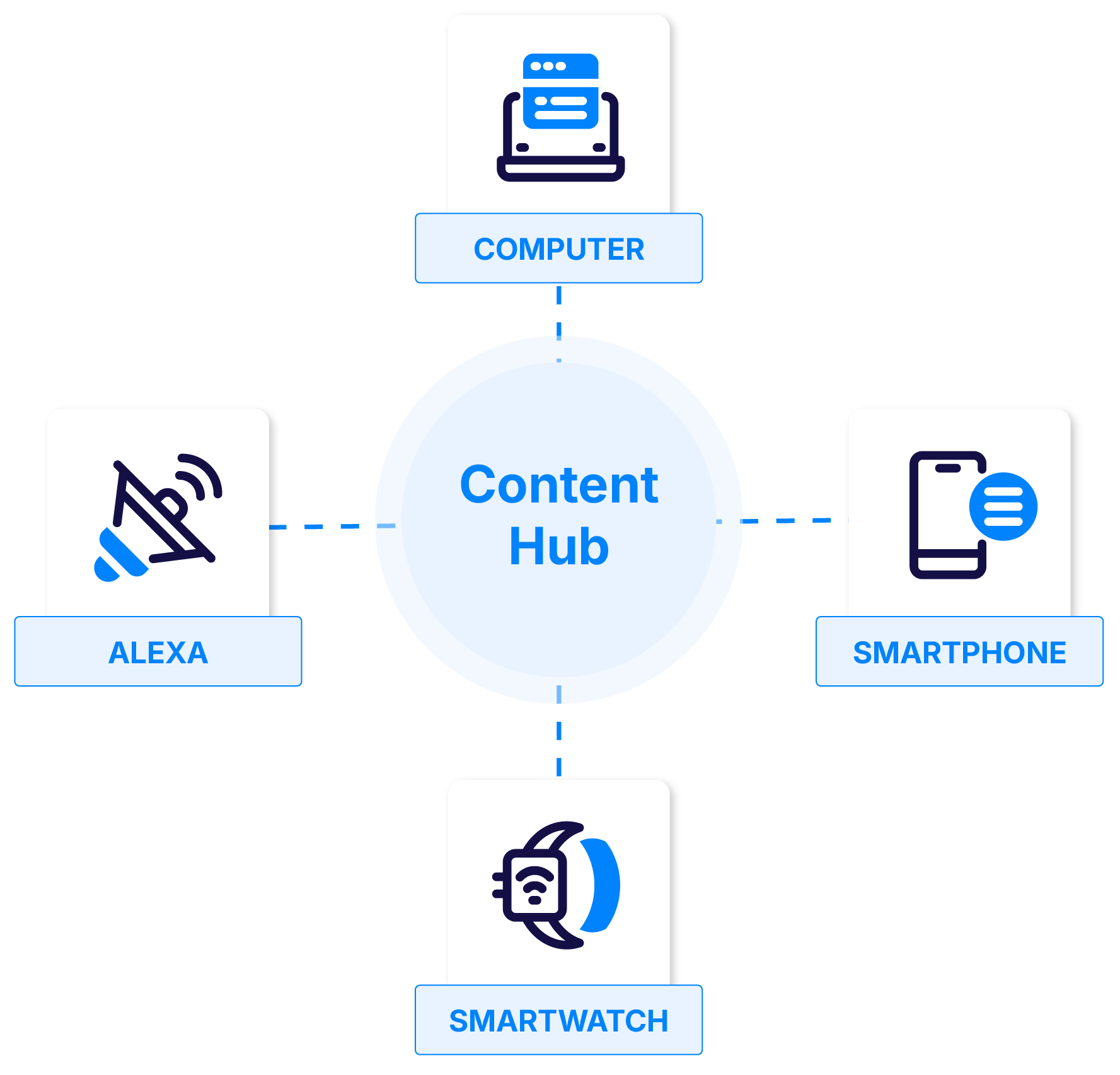
In simpler terms, it’s a CMS that cuts off the “head” (the website or app front-end), leaving just the body (the content hub), which can feed any “head” you attach. Content is stored in a structured format (think entries with fields like title, images, body text, etc.), and developers retrieve that content using API calls to display it in any user interface they choose.
Because the content backend is frontend-agnostic and API-driven, you could use the same content to power your website, mobile applications, smartwatches, voice assistants, or even a fridge display, whatever channel comes next. This flexibility is a game-changer for delivering omnichannel content.
Flotiq example
To illustrate, consider how Flotiq works as a headless CMS: content creators use Flotiq’s intuitive interface to input and organize content, and that content is instantly available through Flotiq’s API. Developers can then fetch and render that content on any platform or device.
The CMS doesn’t impose how the content should look or where it should go – that’s entirely up to your front-end design and logic. This decoupling means your content is no longer trapped in a single website; instead, it’s liberated for use anywhere.
As a result, adopting a headless CMS like Flotiq brings enormous agility. Teams can redesign or rebrand front-end experiences independently, without migrating or restructuring the content repository. And when a new channel (say, an AR/VR application or the next big social platform) becomes relevant, you can plug it into the same content pool via API, future-proofing your content strategy.
Analogy: A streaming service for content
Think of a headless CMS as a high-quality streaming service for your content. Your content is stored in one central library (the backend), but subscribers (different devices and applications) can stream that content on demand through an API.
Much like how Netflix delivers the same movie to a phone, a smart TV, or a laptop, a headless CMS delivers the same structured content to a website, mobile app, or smart device. The content remains consistent, while the viewing experience is tailored to each device.
Traditional vs. Headless CMS
In a traditional (monolithic) CMS, the front-end and back-end are tightly integrated. Platforms like WordPress, Drupal, or Joomla were originally built to both store content and control exactly how it is presented on a web page (using themes or templates).
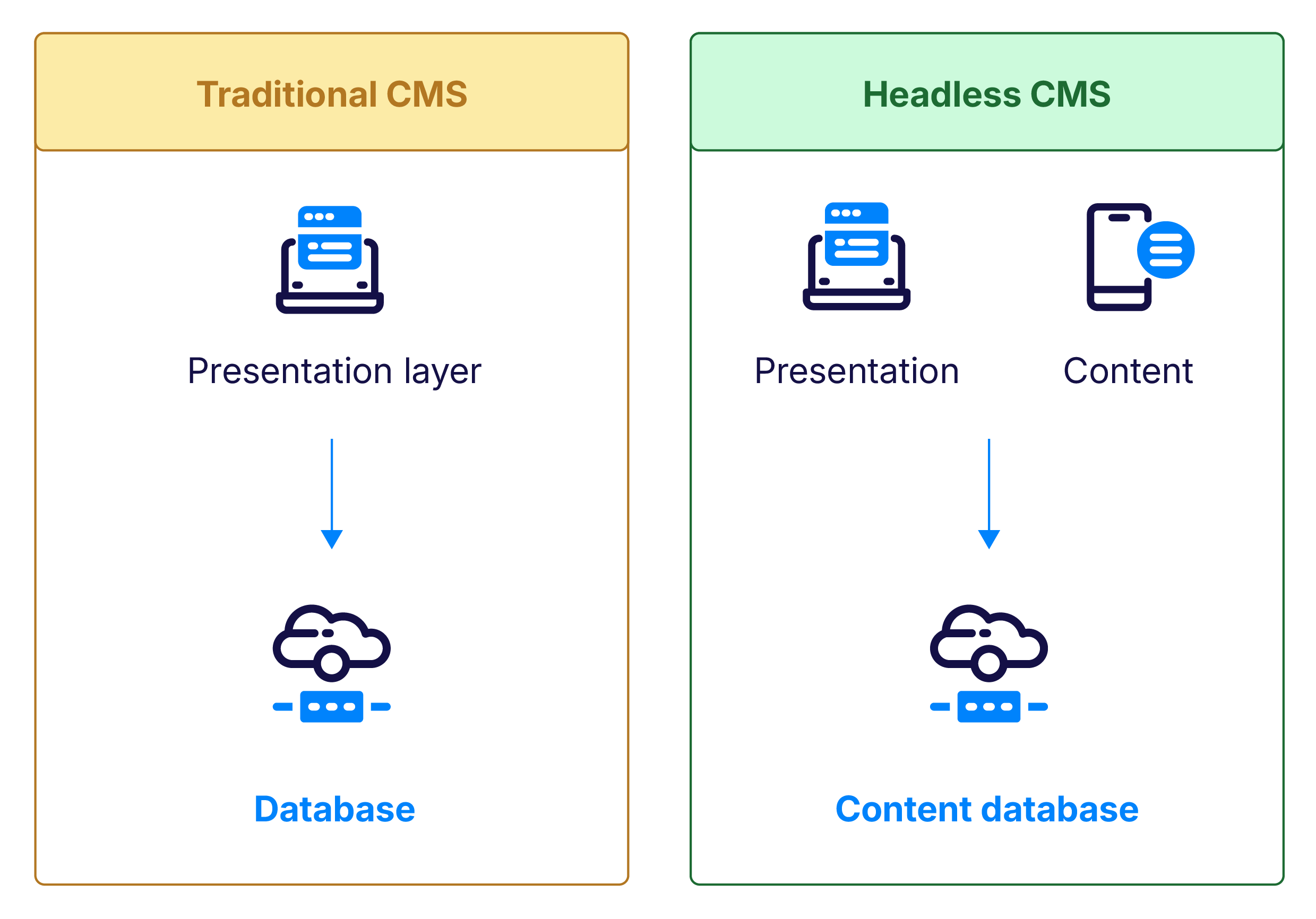
This all-in-one approach made it simple to set up basic websites, but it comes with significant limitations in today’s multichannel world.
Key differences
- Tightly coupled vs. decoupled: Traditional CMS ties database, code, and design together; headless CMS separates content from presentation.
- Limited channels vs. omnichannel: Traditional CMS was built for websites only; headless CMS delivers to any platform that can make web requests.
- Slower updates vs. rapid publishing: Traditional CMS is slower to update; headless CMS enables parallel dev + content workflows.
- Performance: Traditional CMS often requires rendering for each request; headless CMS uses CDNs and static generation for speed.
- Developer & editor experience: Traditional CMS locks developers into frameworks and burdens editors with design decisions; headless CMS gives devs freedom and editors a cleaner experience.
📊 Stat: 69% of organizations that switched to a headless CMS reported improved time-to-market for content and campaigns.
Why legacy CMS falls short
Ultimately, legacy coupled CMS were not designed for today’s explosion of channels and devices. They can become bottlenecks for innovation – for example, over half of companies said their old CMS prevented them from quickly bringing new services to market.
📌 Case Study: When Autoweb, an automotive marketing company, moved from a custom traditional CMS to a headless approach, they significantly sped up content production and saw monthly page views jump by 95%.
How Headless CMS unlocks digital potential (key benefits)
Adopting a headless CMS unlocks a wide range of benefits that empower developers, marketers, and decision-makers alike.
- Omnichannel content delivery: Deliver consistent content across any channel.
- Faster time-to-market & agility: Decoupling accelerates dev cycles and publishing.
- Flexible, API-driven integrations: Works seamlessly with other tools.
- Consistent user experience & personalization: Structured content enables tailored experiences.
- Improved performance & scalability: CDN + static generation = fast load times and scale.
- Enhanced security: API-only reduces attack surface.
- Empowering content teams & editors: Workflows, versioning, permissions free editors from template constraints.
- Lower maintenance & operational costs: Cloud-hosted headless CMS reduces IT overhead.

Closing Part 1
The case for headless CMS is clear: it’s faster, more flexible, more scalable, and future-proof.
👉 In Part 2, we’ll explore the top 13 headless CMS platforms, dive deeper into omnichannel and API-driven strategies, and show how Flotiq brings all these benefits together.

.png)